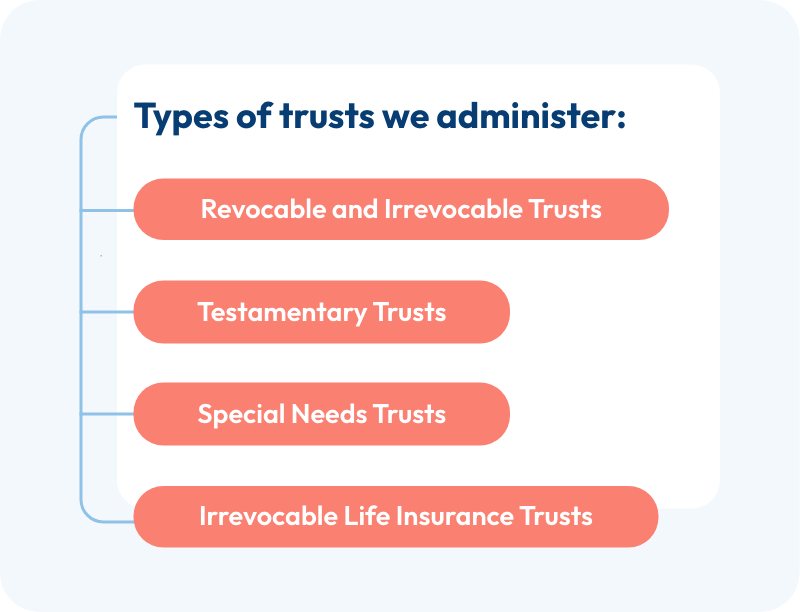
As your Trustee, we are responsible for the administration of your trust. We collect and manage all the assets in the trust, pay bills and taxes, and distribute what remains to the beneficiaries exactly as the trust specifies.
Our job is to be fair to everyone involved – we treat all beneficiaries equally and always put their best interests first. We act as a neutral unbiased party working to ensure everything goes smoothly and everyone is treated fairly.

As your court-appointed Executor or Personal Representative, we’re here to handle the probate process with care and expertise. Think of probate as the legal journey that happens after someone passes away. It’s how we make sure their final wishes are respected, bills are paid, and their estate is distributed to the right people or charitable organizations.
We’ll work closely with the probate court to handle all the details, from managing the estate to distributing assets to loved ones. Our goal is to make this complex process as smooth and stress-free as possible for your family.




We offer consulting services to meet a variety of our clients’ needs, drawing on our unique background and expertise. Whether you need advice on growing and protecting your assets or planning for the future, we’ll work closely with you to provide tailored solutions to help you reach your goals.
In its simplest terms, after a Trustee has accepted their appointment, they must marshal the assets of the trust, pay off any and all liabilities and distribute the assets according to the terms of the trust document.
In reality, anyone who has ever settled an estate or administered a trust for someone else can tell you that it is a lot of work and very time-consuming.
An executor or Personal Representative is a person or institution named in a will to carry out the wishes of the deceased and settle their estate. An executor can also be appointed by the Probate Court as the administrator of a decedent’s estate.
The role of executor can be time-intensive and carries a great deal of responsibility. Executors are personally liable for their actions and can face financial or legal consequences if they perform their duties incorrectly
The executor’s primary responsibility is to ensure that the estate is administered and distributed according to the terms of the will and in compliance with applicable laws.
The executor’s duties include:
Guardianship responsibilities typically fall into two categories:
Types of Power of Attorney:
Responsibilities of the Agent:
Scope and Limitations:
The Agent must act in good faith and avoid conflicts of interest. An Agent under a POA plays a crucial role in ensuring the Principal’s affairs are handled responsibly, particularly in times of incapacity or unavailability.